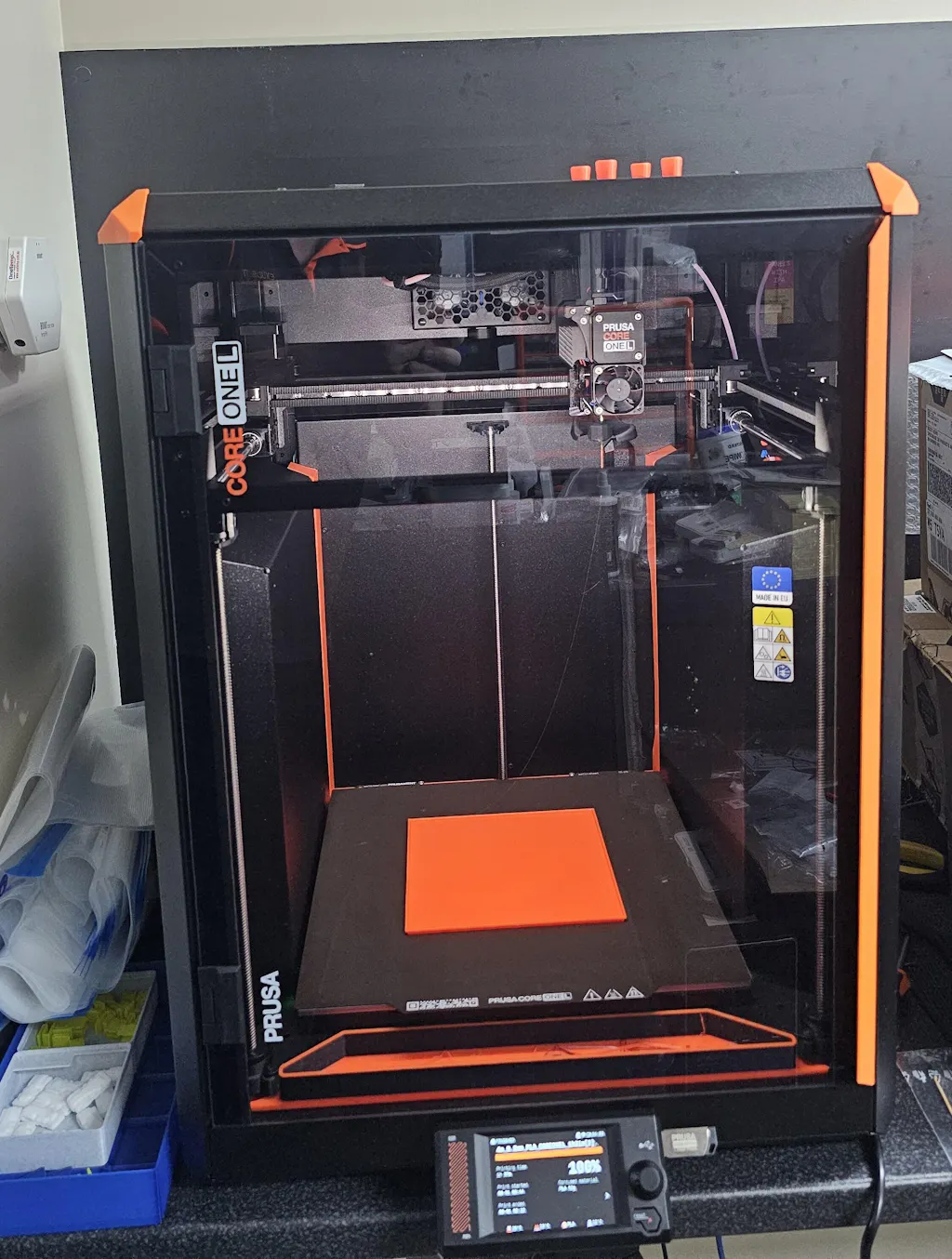
Prusa Core One L High-Speed CoreXY 3D Printer
NOW IN PRODUCTION
- Pickup: Contact us about pickup or we install for you
- On-Site Training: Need a wakl through, we come to you
- Delivery: FREE shipping direct from Prusa – 15-20 business days for despatch.
Double the Volume, Same Legendary Reliability – Prusa's Largest CoreXY Just Got Serious
The Core One L is Prusa's answer to everyone who loved the original Core One but needed more room to work. You get 63% more build volume - a generous 300 × 300 × 330mm - without sacrificing the speed or precision that made the standard model a favourite. This isn't just a bigger box with a larger bed. Prusa's redesigned the whole thermal system with AC convection heating that brings the chamber to temperature faster and holds it there more consistently than passive systems.
What really sets the Core One L apart is how it handles real production work. The actively heated chamber reaches 60°C, which means you can print temperature-sensitive materials like ABS and ASA without warping or layer separation. The dual filament sensors catch problems before they ruin your print, and the loadcell system automatically calibrates the first layer - no manual tramming, no paper test, just reliable first-layer adhesion every time.
This is a CoreXY machine built for Australian workshops and design studios that need to produce functional parts, not just prototypes. The 0.9-degree stepper motors on the X and Y axes eliminate the vertical banding you see on cheaper printers, and the Input Shaper system lets you push speeds up to serious production levels without losing quality. It arrives pre-calibrated from the factory, which means you're printing within minutes of unboxing, not spending a weekend tweaking settings.

KEY INNOVATION: AC convection heatbed heating changes everything about how this printer handles engineering materials. Two fans underneath the bed create a convection effect that distributes heat edge to edge - no cold corners, no thermal gradients causing first-layer adhesion problems. The bed reaches 120°C faster than traditional systems and holds that temperature consistently across the entire 300 × 300mm surface. Combined with the 60°C chamber heating, you get the thermal stability needed for nylon, polycarbonate, and other demanding materials that lesser machines struggle with.

CoreXY Motion System Built for Speed
The CoreXY architecture moves the print head with two motors working together, which means lighter moving parts and dramatically faster acceleration without sacrificing precision. Where traditional bed-slinger designs hit their limits around 150-200mm/s, the Core One L keeps going. The Input Shaper feature with built-in accelerometer actively compensates for resonance, letting you push print speeds without introducing artefacts or layer inconsistencies.
Those 0.9-degree stepper motors on the X and Y axes aren't just marketing specs - they make a visible difference in print quality. You get smoother circles, cleaner curves, and no vertical fine artefacts (VFAs) that show up as subtle banding on curved surfaces. It's the kind of detail that separates functional prototypes from parts you can actually use in production.
The exoskeleton steel frame with aluminium panels keeps everything rigid during fast moves. There's no frame flex, no wobble, and the whole structure maintains dimensional accuracy whether you're printing at conservative speeds or pushing the machine hard.

Nextruder Direct Drive - Real Versatility
The Nextruder direct drive extruder handles everything from flexible TPU to abrasive carbon-fibre composites. You get two nozzles included: a high-flow brass CHT for standard materials and an abrasive-resistant nozzle for engineering filaments. The quick-swap system means changing nozzles takes less time than swapping print sheets.
That 10:1 planetary gear reduction gives you the torque needed for consistent extrusion with challenging materials. The 360-degree turbine cooling wraps around the nozzle, which means excellent cooling for overhangs and bridges regardless of which direction the toolhead's travelling. Print orientation doesn't affect cooling performance.
The dual filament sensors work together - one detects when you're running out, the other monitors the actual filament movement to catch clogs or jams before they ruin your print. There's even a flexible filament mode that adjusts sensor sensitivity for TPU and other soft materials that can false-trigger standard sensors.

Thermal Management That Actually Works
Getting the chamber to 60°C isn't just about the numbers - it's about maintaining dimensional accuracy on large ABS or ASA prints. The AC convection system heats actively rather than relying on waste heat from the bed, which means consistent temperatures throughout the chamber, not just near the print surface.
The heatbed reaches 120°C, which opens up materials like polycarbonate and nylon that need serious bed temperatures for adhesion. Five high-precision Semitec thermistors monitor temperatures across the printer, feeding data to the custom xBuddy mainboard for precise thermal control.
You'll notice the difference immediately with materials like ABS - parts don't warp, corners don't lift, and large prints maintain their dimensions through the entire build. The magnetic PEI spring steel sheets release parts easily once they cool, and the removable sheet system means you can have one cooling while another's on the printer.

Built for Production Reliability
The loadcell sensor handles automatic first-layer calibration across the entire print area. No mesh bed levelling across unused space - it maps only where you're actually printing, which speeds up the process and adapts to different print sizes intelligently.
The 1080p camera with night vision lets you monitor prints remotely through Prusa Connect. Whether you're using the mobile app from home or checking on a print farm from the office, you get clear visibility on how prints are progressing. The camera's optional during setup, but once you've got it installed, you'll wonder how you managed without remote monitoring.
All the electronics are accessible without tools - no glued-in components that require destructive disassembly for repairs. This is a machine designed for maintenance and longevity, not planned obsolescence. When something eventually wears out, you can replace it yourself rather than sending the whole printer back.

Open-Source Freedom and Ecosystem
The Core One L runs on open-source firmware available on GitHub, which means you're not locked into proprietary software or manufacturer-controlled updates. PrusaSlicer comes with over 200 factory-tested material profiles optimised for Australian and international filament brands, but you're free to use any slicer that outputs standard G-code.
The printer works completely offline if that's what your environment requires - no cloud accounts, no mandatory internet connection, no data leaving your facility. For those who want remote management, Prusa Connect provides web-based and mobile app monitoring without forcing you into a subscription model. You choose how you want to work.
Integration with Printables.com gives you access to hundreds of thousands of free, tested models, though you're equally free to use any STL or 3MF files from any source. This is a tool that adapts to your workflow, not the other way around.
Australian Industry Applications
Product Design & Rapid Prototyping
Australian design studios need quick iterations without compromising on detail. The Core One L's 300mm cube build volume means you can prototype full-scale models rather than scaled-down representations. Print functional housings, test fitments, and validate mechanical assemblies at actual size. The heated chamber handles engineering-grade materials, so your prototypes can go straight into environmental testing or client presentations without disclaimers about material properties.
Manufacturing & Tooling
The combination of build volume and thermal stability makes the Core One L practical for jigs, fixtures, and manufacturing aids. Print custom assembly jigs in nylon for durability, create vacuum forming tools in high-temperature materials, or produce low-volume production parts in carbon-fibre reinforced filaments. The dual filament sensors and automatic calibration reduce failed prints, which matters when you're running overnight production batches.
Education & Research
Universities and TAFEs across Australia are teaching additive manufacturing as core curriculum, not optional extras. The Core One L gives students experience with industrial CoreXY architecture whilst remaining accessible enough for undergraduate use. The open-source firmware and software ecosystem supports research projects, and Prusa's documentation means students can understand how everything works rather than treating it as a black box.
Engineering & Functional Parts
When you need a custom mounting bracket, replacement housing, or one-off mechanical component, the Core One L delivers parts with genuine structural integrity. The ability to print nylon, polycarbonate, and composite materials means engineered parts that hold up under real-world loads. Print spare parts for older equipment that's out of production, create custom adaptors for unique installations, or prototype mechanical designs before committing to CNC machining.
Architecture & Construction
Architectural models benefit from the large build volume - you can print entire building sections at useful scales rather than chopping models into small segments. The precision and surface quality make client presentations more impressive, and the material variety means you can differentiate elements by colour and finish. Scale models for construction planning, conceptual massing studies, or heritage documentation all fit within the build volume.
Print Farms & Service Bureaus
The Core One L's reliability and automation features make sense for commercial printing operations. Pre-calibrated delivery, automatic first-layer setup, and comprehensive monitoring reduce operator intervention. The network connectivity means you can manage multiple printers from Prusa Connect, and the upcoming MMU3 multi-material support (early 2026) opens up new service possibilities without operator supervision on colour changes.

Product Family Context
The Core One L is the big brother in Prusa's Core series, offering 63% more build volume than the standard Core One. If your projects typically fit within 250mm, the younger Core One delivers the same CoreXY reliability in a more compact footprint for $2,200-$2,549. Need even more space or multi-material capabilities? The flagship Prusa XL takes it to the next level with a massive 360×360×360mm build volume and up to 5-toolhead multi-material printing.
You Might Also Consider from ADD Labs
If the Core One L is more printer than you need:
Prusa Core One ($2,200 kit / $2,549 assembled) - Same CoreXY architecture and actively heated chamber (55°C) in a more compact 250×220×270mm build volume. Perfect if your designs rarely exceed 250mm and you want to save desk space. Same Nextruder direct drive, same Input Shaper precision, same Prusa reliability.
If you need more capability:
Prusa XL (contact for pricing) - Massive 360×360×360mm build volume with optional multi-material system supporting up to 5 independent toolheads. Zero-waste toolchanger technology and segmented heatbed make this Prusa's flagship for production environments. When single-material printing isn't enough and you need true multi-colour or multi-material capabilities without waste.

Stock & Delivery: The Core One L is Prusa's latest release, with shipping commencing November 2025. ADD Labs accepts pre-orders now with dispatch following Prusa's manufacturing schedule. Once stock arrives in Sydney, we ship within 1-2 business days with delivery across Australia taking 2-8 business days depending on your location. For current availability and estimated delivery to your area, contact our Sydney team on 02 9161 4164.
Technical Parameters
View Full Technical Specifications
| Build Volume & Dimensions | |
| Build Volume | 300 × 300 × 330mm |
| Print Area | 63% larger than Core One standard |
| Layer Height Range | 0.05-0.30mm |
| Filament Diameter | 1.75mm |
| Printer Weight | 21.9kg |
| Machine Dimensions | 469 × 521 × 635mm (W×D×H) |
| Extruder System | |
| Type | Nextruder Direct Drive |
| E3D V6 Compatible | Yes (with adapter) |
| Cooling System | 360-degree turbine |
| Included Nozzles | High-flow brass CHT 0.4mm + Abrasive-resistant 0.4mm |
| Quick-Swap Nozzles | Yes |
| Gearbox Ratio | 10:1 planetary gear system |
| Temperature Capabilities | |
| Nozzle Temperature | Up to 290°C |
| Heatbed Temperature | Up to 120°C |
| Chamber Temperature | Up to 60°C (actively heated) |
| Thermistors | Five high-precision Semitec units |
| Motion System | |
| Architecture | CoreXY |
| Stepper Motors | 0.9-degree precision (X, Y axes) |
| Stepper Drivers | Trinamic 2130 |
| Input Shaper | Yes |
| Accelerometer | Built-in |
| Phase Stepping | Yes |
| Electronics & Control | |
| Mainboard | Custom 32-bit xBuddy (STM32 processor) |
| Display | 3.5-inch colour touchscreen |
| Connectivity | Ethernet, Wi-Fi (removable module), USB |
| GPIO Board Compatible | Yes |
| Sensors & Monitoring | |
| Filament Sensors | Dual (with flexible filament mode) |
| Loadcell Sensor | Yes (automatic first-layer calibration) |
| Door Sensor | Yes |
| Fan Monitoring | Yes |
| Camera | 1080p with night vision (optional installation) |
| Print Surface & Calibration | |
| Bed Type | Magnetic heatbed with AC convection |
| Surface | Removable PEI spring steel sheets |
| Heat Distribution | Edge-to-edge uniform |
| Automatic Levelling | Mesh bed (print area only) |
| Materials Compatibility | |
| Standard Materials | PLA, PETG, Flex, PVA, PC, PP, CPE, PVB |
| With Advanced Filtration | ABS, ASA, HIPS, PA (Nylon) |
| Temperature Range | Up to 290°C nozzle temperature |
| Optional Accessories | |
| MMU3 Multi-Material | Compatible (available early 2026) |
| Advanced Filtration | For ABS/ASA/Nylon printing |
| Critical Infrastructure Edition | Wi-Fi removed, encrypted USB included |
| Power & Consumption | |
| Input Voltage | 240V AC 50Hz (Australian standard) |
| Power Cable | Australian plug included |
What's Included in the Box

- Prusa Core One L printer (factory pre-calibrated)
- Power cable with Australian plug
- One additional PEI spring steel print sheet
- High-flow brass CHT nozzle 0.4mm (installed)
- Abrasive-resistant nozzle 0.4mm
- English handbook and documentation
- 1080p night vision camera (optional installation during setup)
Software & Ecosystem
Included Software
- PrusaSlicer: Open-source slicer with 200+ factory-tested material profiles
- Prusa Connect: Print management and remote monitoring platform
- EasyPrint: Web-based cloud and offline slicing tool
- Native iOS and Android apps: Mobile monitoring and control
Software Features
- 100% Offline Operation: No account or internet required
- Open-Source Firmware: Available on GitHub
- No Vendor Lock-In: Standard G-code compatible
- Printables.com Integration: Access to hundreds of thousands of free models
- Factory-Tested Profiles: Material settings optimised for Australian filament brands
Frequently Asked Questions
How long does initial setup take?
The Core One L arrives pre-calibrated from Prusa's factory. Unboxing to first print typically takes about 5 minutes. You'll remove protective packaging, install the print sheet, load filament, and start printing. No manual calibration or bed tramming required - the loadcell sensor handles first-layer setup automatically.
What's the real-world difference between the Core One and Core One L?
Build volume. The L gives you 300 × 300 × 330mm versus the standard model's 250×220×270mm - that's 63% more printing space. Everything else remains essentially the same: same CoreXY motion system, same Nextruder extruder, same thermal capabilities. If your projects consistently hit size limitations on smaller printers, the L solves that problem. If you rarely print anything over 200mm, the standard Core One saves desk space.
Can I print ABS and ASA without the advanced filtration system?
Technically yes, but it's not recommended for indoor environments. The 60°C heated chamber handles the thermal requirements perfectly, and you'll get excellent results quality-wise. However, ABS and ASA release styrene fumes that aren't pleasant and shouldn't be breathed in enclosed spaces. The advanced filtration system is essential if you're printing these materials in offices, classrooms, or workshops without dedicated ventilation. For occasional ABS use, you might get away with good room ventilation, but regular production work needs proper filtration.
Does this work with Australian voltage and power outlets?
Yes, completely. The Core One L includes an Australian power cable and operates on 240V AC 50Hz. Plug it straight into any standard Australian power point - no transformers or adaptors needed.
What's the actual print speed in real-world use?
Prusa doesn't market specific mm/s speed numbers because real-world speed depends on geometry, material, and quality requirements. The CoreXY motion system with Input Shaper handles high acceleration without quality loss. You'll see significantly faster print times than traditional bed-slinger designs, especially on taller prints where the Core One L's lightweight toolhead movement shows its advantage. For reference, users report functional PETG parts printing 2-3x faster than on i3-style machines whilst maintaining equivalent quality.
Is the Wi-Fi module removable if I'm using this in a secure environment?
Yes. The Wi-Fi module is physically removable for security-conscious installations. Prusa even offers a "Critical Infrastructure Edition" with the Wi-Fi circuitry completely removed from the factory, no camera option, and an encrypted USB drive included. You can run the printer entirely offline via USB or Ethernet if that suits your environment better.
When will MMU3 multi-material support be available?
Prusa has announced early 2026 for MMU3 compatibility with the Core One series. The printer's already designed for the upgrade - you'll add the MMU3 unit when it's released without needing to modify the existing machine.
How does the camera work, and is it required?
The 1080p camera with night vision is included but optional during setup. If you install it, you get remote monitoring through Prusa Connect's web interface or mobile apps. It's particularly useful for long prints or when running multiple printers - you can check progress without physically visiting the machine. The night vision works even when room lights are off, so you can monitor overnight prints. If you don't install it initially, you can add it later.
What happens if I run out of filament mid-print?
The dual filament sensor system detects when the spool is empty and automatically pauses the print. You load new filament, tell the printer to continue, and it resumes right where it stopped. The pause/resume is clean enough that you often can't see where the filament swap occurred in the finished part. This works for planned colour changes as well as unplanned runouts.
Can I use third-party filaments, or am I locked into Prusa materials?
Complete freedom. The Core One L works with any quality 1.75mm filament from any manufacturer. PrusaSlicer includes profiles for major filament brands, and you can create custom profiles for specific materials. There's no vendor lock-in, no RFID restrictions, no proprietary cartridges. Use whatever filament makes sense for your application and budget.
How noisy is the Core One L during operation?
The CoreXY motion system with quality stepper drivers runs quieter than most bed-slinger designs. The loudest components are the cooling fans, particularly during the first layer when all fans are running. During normal printing, noise levels are comparable to a desktop computer under load - noticeable in a quiet room but not disruptive in a typical workshop or studio environment. The actively heated chamber adds some fan noise, but it's a steady hum rather than variable whine.
What maintenance does the Core One L require?
Regular maintenance is straightforward. Lubricate the linear rods and lead screws every few months depending on usage. Clean the nozzle and check for partial clogs if you notice extrusion issues. The PEI print surface needs occasional cleaning with isopropyl alcohol to maintain adhesion. Replace the nozzle when printing abrasive materials - it's a 30-second job with the quick-swap system. Prusa's documentation covers all maintenance procedures with clear instructions and recommended intervals.
Is technical support available in Australia?
Yes. ADD Labs provides local Australian technical support with technicians who understand the Core One L thoroughly. Call 02 9161 4164 during business hours for assistance with setup, troubleshooting, material selection, or optimisation. We also offer on-site training and installation support for education and commercial customers. All service parts ship from our Sydney location for fast delivery across Australia.
Australian Warranty & Support
The Prusa Core One L comes with Prusa's standard manufacturer warranty covering defects in materials and workmanship. ADD Labs provides local Australian support with technicians who understand the machine inside and out. When you've got questions about material settings, troubleshooting, or optimisation, you're calling Sydney, not waiting for responses from overseas.
All service parts are available through ADD Labs for next-day delivery to Australian metro areas. The tool-free design means most maintenance and repairs are user-serviceable - no factory return required for wear items or component replacements. Prusa's open-source firmware and active community mean solutions to common issues are well-documented and freely shared.
For education and business customers, ADD Labs offers installation support, material consultation, and workflow optimisation services. If you're deploying multiple printers or setting up a print farm, our team can help with network configuration, print queue management, and operator training.
Contact ADD Labs Sydney on 02 9161 4164 for technical support, material recommendations, or to discuss volume purchases for educational and commercial deployments.
Why Choose Core One L?
The Core One L fills a specific gap in the Australian market: a genuinely reliable production printer with serious build volume that doesn't require a specialist to operate. You're not buying into a closed ecosystem or proprietary material system. You're getting open-source firmware, standard G-code compatibility, and the freedom to use whatever materials and software make sense for your work.
Prusa's reputation for reliability isn't marketing - these machines run production print farms 24/7 because they're designed for it. The pre-calibration from the factory, automatic first-layer setup, and comprehensive monitoring reduce the operator intervention that makes other printers impractical for serious production use.
The 300mm cube build volume means fewer compromises on design. Print full-scale prototypes, complete assemblies, or larger functional parts without segmentation. The actively heated chamber and high-temperature capabilities extend that versatility to engineering materials that cheaper printers simply can't handle reliably.
Ready to see what the Core One L can handle? Call ADD Labs Sydney on 02 9161 4164 to discuss your specific applications, arrange a demonstration, or talk through material compatibility for your projects. Our team knows this machine thoroughly and can help you determine if it's the right fit for your workshop, studio, or facility.